

American Muslim Youth And The Tar Sands – "We Want A Bright, Not A Blackened Future"
Posted by Zaufishan American-Muslims, Eco-Islam, Green-Muslims, Islam-Environment, Middle-East, muslim lifestyle, political correctness Thursday, September 01, 2011
Matthew Naim Abdullah, an environmental activist from California writes during Ramadan about why the proposed Keystone XL oil pipeline is a bad idea.
It is nearing the onset of sunset in San Diego, California – an idyllic suburb in many respects, although mere kilometers away from a Mexican border that is wracked with blood, sweat, and tears. The Islamic maghrib prayer will occur soon, and dutiful Muslims arrive hungry and tired for one of the final nights of Ramadan, a time for spiritual contemplation and self-purification.
Some will spend the time sleeping and praying for redemption in their preferred mosque. Some will gorge on high-cholesterol Middle Eastern food, and consequently endure abdominal pain and insomnia most of the night. Others will simply spend quality time with their families.
My path is a little different, however, as I will most likely spend the last day or two of Ramadan in jail.
Over the next few days, I will travel to Washington DC to participate in the Tar Sands Action {tarsandaction.org}, a nonviolent civil disobedience gathering in front of the White House to protest the proposed Keystone XL oil pipeline, repping individuals from all 50 states and all walks of life.
Muslims from around the world are aware of the insidious effects of oil and other fossil fuels on our daily lives. Gulf states regularly exploit workers from South Asia in their pursuit of hyper-industrial development, air pollution ravages nations such as Egypt and Iran, and African resources such as the Niger delta have been systematically raped and pillaged by post-colonial powers and multinational corporations.
These woes are precisely why many wince when they hear about this pipeline, which will purportedly run from Alberta, Canada all the way to refineries on the Gulf Coast of Texas, criss-crossing through multiple Midwest regions on the way there. If you take a look at the map on the aforementioned link, it rivals the transcontinental railroad in all its megalomaniacal glory.
Sadly, the Obama administration shows no sign of withstanding the onslaught of energy lobbyists salivating over this pipeline. According to the New York Times, the State Department just released a report concluding that the pipeline would exert only minimal environmental effects.
Never mind that the report minimizes - that is, completely ignores, the effects of the pipeline on carbon emissions, which will be so nasty that they will ‘essentially [spell] game over for the climate,” according to the world’s top climatologist James Hansen. Never mind that the pipeline runs straight through the Ogallala Aquifer - one of the largest freshwater reserves in the world - as well as the Yellowstone River and fragile ecosystems such as the Nebraska Sandhills. Never mind that yet another oil pipeline will further obstruct our ability to move towards a clean-energy economy. Not like we were moving in the first place. We didn’t even get a climate bill.
As Muslims, we are required to stand up to injustice wherever we see it - with our hearts, our bodies, and our minds.
This remains true whether we are struggling against oppressors in Egypt or Libya, or whether we are fighting for policy reforms in the United States that will have transnational effects on poor and marginalized populations. The Qur’an reminds us that we need to ‘strive hard’ against the actions of ungrateful and two-faced entities that value private gain over public welfare (9:73). In addition, the sacred book states that our civil struggles are a necessary sociological phenomenon if we wish to avoid the physical or moral corruption of all people. As the brilliant Qur'an translator Muhammad Asad noted,
“….if God had not enabled people to defend themselves against one another, corruption would surely overwhelm the earth.“ (Qur'an, 2:251).
As young people, we will all suffer from the hazards of climate change, no matter what we adhere to in terms of religion, ethnoracial identity, or socioeconomic standing. If we as Muslims wish to provide a vital contribution to global movements such as climate justice, we need to reduce the fragmentation, insularity, and often-cynical identity politics seen in many of our communities and civil society organizations. Yes, we encounter struggles against discrimination and alienation, many of us almost daily. But let’s not let issues such as Islamophobia divert us entirely from our participation in movements such as climate change, which require the attention of our entire world.
And we do have reason to participate in efforts such as the Tar Sands Action, as our communities around the world will be affected. Not all Muslim groups around the world respond to climate collapse in a civil or peaceful way, as we have seen from the genocidal massacre related to resource conflicts in the Darfur region. In fact, they might respond in a much more violent and reactionary manner. And in an era where resource-related conflicts will be exploited by wealthy special interests, war profiteers and corporate media outlets might realize that they have much to gain by creating a caricature of ‘eco-terrorist Muslims’ as evil villains. This could potentially cause scapegoat-like rage against the Muslim world, with elite land grabs and Great Game-like wargames expressed as euphemisms such as international ‘interventions’ and local ‘security incidents.’
However, there is reason for hope. Our Arab Spring brothers and sisters overseas have singlehandedly taken down decades-long dictators such as Ben Ali, Mubarak, and Gaddafi, mostly through civil and non-aggressive means on their part. Therefore, this vibrant revolutionary environment in the Arab Spring nations serves as the perfect opportunity for us to affirm the civil and peaceful principles that will guide future climate justice efforts in Muslim-majority societies. Hopefully, we can then begin to push the tide towards peaceful protests and international solidarity, rather than towards reactionary violence and balkanization.
Ramadan arrived, and it has left us. Many words have been spoken about the value of putting faith into action, but it is now time for action itself - which is why I will be joining over 2000 individuals at the White House this week to make a stance.
{Tar Sands Action}
By Matthew Naim Abdullah, an environmental and political activist from California.
Image:: flickr
'Trees4Life' Invite You To Plant A Tree In Indonesia
Posted by Zaufishan asia, competitions, Eco-Islam, events, Islam-Environment, Muslim-Media, Muslim-News Saturday, August 13, 2011
Trees4Life Campaign, an environmental initiative ran by British Muslim activists, has launched ‘Poetry in Motion - The Green Poetry Challenge 2011’. The project has added eco-value by fundraising to plant trees in Indonesia where Trees4Life has already established Earth saving plans.
The poetry competition is open to all creative writers and invites you to write a poem about the environment. This is in support of the "Green Burqettes", three Muslim women from Manchester who recently took part in the Fusion Rally {http://thefusionrally.com} epic 5-day drive from London to Andalusia to help raise money to plant trees in Indonesia.
There are 3 categories of entrants; adults, secondary age pupils and primary age pupils, who are being invited to take part in the poetry challenge to write a poem about the environment.
MUSLIMNESS invites you to participate in this poetry challenge and make a donation towards their drive in the chance to win a fantastic trip and plant a beautiful sapling tree - a good deed and sunnah in itself.
Just £5 enters you into the challenge and buys you a tree. All submissions will receive an e-Certificate of Plantation acknowledging the planting of the tree in Indonesia.
Prizes include a trip to Kew Gardens, donated by Shining Ummah Awards (part of the Creative Muslim Network).
CLOSING DATE: Friday 21st October 2011
For full terms and conditions, details of the prizes and how to register visit:
Support environmental action by donating on the Green Burqettes fundraising page, www.charitygiving.co.uk/greenburqettes. Join the Trees4Life poetry challenge Facebook events page.
Judges:
Abrar Hussain - Fusion Rally, Ayman Raze - "Tawheed is Unity", Naeem Darr - MDUK Media, Shemiza Rashid - Creative Muslim Network. More to be confirmed.
Sponsored by:
Islamic Travels and supported by "Tawheed Is Unity", the Creative Muslim Network, Shining Ummah Academy, YMWA, MWA, MDUK Media.
"Thanks for supporting the preservation of the Earth", Trees4Life Campaign Team.
Can Muslims Be Buried At Sea?
Eco Muslim Blogs Make The www Greener
Recipe: Make Authentic Turkish Coffee Like A Native
Get 'Fit4Ramadan', The Fitness Program For Muslims
Plans For Cleaner Zam Zam Distribution In Madinah
Can Muslims Be Buried At Sea?
Posted by Zaufishan death, Eco-Islam, Islam-Environment, Middle-East, muslim lifestyle Wednesday, June 29, 2011
Muslim burial rights are eco-friendly
In May, the world’s most wanted man, Osama bin Laden, was laid to rest somewhere in the Arabian sea, which some are calling the ultimate green burial. US officials told news agencies the sea burial followed Islamic customs. Bin Laden’s body was ritually washed, shrouded in a plain white sheet and placed in a weighted bag. Arabic prayers were said over the body, which was then tilted off a flat board from the deck of the USS aircraft carrier Carl Vinson and allowed to slide off into the sea.
While there is no strict time frame for Muslim burials, senior US officials focused on disposing the body within 24 hours, out of respect for the Muslim community, and the decomposing process. This 24-hour rule was not applied for Uday and Qusay Hussein – sons of Iraqi leader Saddam – when in 2003 U.S forces preserved their bodies for 11 days through embalmment.
Since the death Muslim scholars have issued statements for and against sea burials and the ethics behind the mystery of a watery grave.
Egyptian lawyer Montasser el-Zayat said Bin Laden’s sea burial was designed to prevent his grave from becoming a shrine or “a symbol”.
 In Islamic tradition, sea burials can be allowed but only in extraordinary cases where the death occurs aboard a ship that is a “long distance from land”. Shiite cleric Ibrahim al-Jabari spoke out that if the death occurs on land, the person “should be buried in the ground… Otherwise this would only be inviting fish to a banquet.”
Sheikh Ahmed al-Tayeb (left) of Egypt’s al-Azhar also condemned the sea burial of Osama bin Laden for being unethical. (Presstv.ir)
How Muslims Bury The Deceased
On land –
Like Jewish burials, the Muslim funeral rites are simple and to the point. Out of respect for the dead cremations are not allowed. Muslims believe the lifeless body still ‘feels’ and will be brought back to life whole. In Islamic teaching the earth and sea are clean burial sites that do not prerequisite elaborate markings or coffins.
- Close family members close the eyes of the deceased and carry out a ritual ablution called ‘ghusl’ – purifying the body thrice with water and perfume.
- The body is wrapped completely with clean sheets, preferably white, known as a ‘kaffan’, similar to coffin.
- Those present make a du`a – an Islamic prayer – and perform ‘salat-ul janazah’, a unique prayer in Arabic for the departed soul.
- The wrapped body is then lowered on its right side into a grave, usually without a box coffin and facing the direction of Makkah. The dug earth covers the grave and a small stone is placed at the head to mark the grave. Earth to earth, dust to dust.
In the sea –
The difference between an earth and sea burial is only in the final resting place. In the words of alislam.org, the shrouded body should be lowered into the water “in a vessel of clay or with a weight tied to its feet”.

Green to the end – the environmental impact of burials
- Water pollution is one of the most commonly cited problems of large cemeteries. As remains are converted to minerals the drainage shifts although drinking sources are not affected negatively.
- Any infective viruses in the deceased can be isolated by surrounding plants. Placing plants with intricate root systems around burial sites is a productive and beautiful way to pull viruses from the soil and counter soil and water contamination, which restricts the movement of microorganisms through the soil.
- If you considered a cremation remember that is uses substantial amounts of energy and fuel, as well as expelling carbon dioxide into the atmosphere – a potent greenhouse gas.
- Sea burials degrade at a slower rate due to the oxygen levels and cooler temperatures.
With the help of natural microbial processes and corrosion, even an eco-coffin made from recycled material will eventually break down into its basic natural elements.
Osama bin Laden’s sea burial is technically eco-friendly but the decision behind it was more politically driven. Akbar Ahmed, the chairman of the Islamic studies department at American University, told the New York Times that sea burial prevented Bin Laden’s resting place from becoming a “powerful shrine”.
“If they allowed Osama bin Laden to be buried in Pakistan, his followers would… plant flowers, and women will say the shrine has healing powers, especially among the uneducated. His myth would continue to grow.”
For Muslims, both land and sea burials are means of connecting with nature: a returning to the original source of organic matter. Although sea burials have minimal environmental impact, every burial method has some contribution to the Earth’s equilibrium.
From Green Prophet | Zaufishan
Plans For Cleaner Zam Zam Distribution In Madinah
Posted by Zaufishan Current-Affairs, Eco-Islam, Islam-Environment, Middle-East, muslim lifestyle Wednesday, June 29, 2011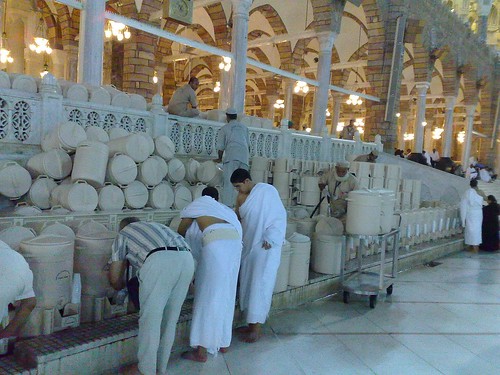
Holy water: the Zam Zam well in Makkah will be bottled and distributed in 42 outlets
Historically preserved as a sacred life source in neighbouring city Makkah, the Zam Zam water well was recently under scientific investigation for arsenic contamination.
A BBC report found the water to be “unsafe for human consumption”, stating that large amounts and regular intakes could pose a serious health risk – including cancer.
In Jeddah, Saudi Arabia, Water and Electricity Minister Abdullah Al-Hussayen disclosed his ministry’s plans to create a Zam Zam water distribution project. This will be established near the Prophet Muhammad’s Mosque (masjid Nabawi) in Madinah, providing an easy access for Hajj pilgrims and travellers.
The automatic Zam Zam water distribution system is networked from a central warehouse, part of King Abdullah’s SR700 million (a little over £117m) Zam Zam Water Project.
“Tenders to implement the project will be opened within two weeks,” said Abdullah Al-Hussayen after opening the water distribution system.
A total of 42 water outlets have been set up for the holy water to be distributed daily. The minister told reporters it would meet the requirements of Muslims pilgrims who come for both Hajj and Umrah. Issues of the arsenic contamination and health risks however, still linger.
The water will be bottled directly from a bottling factory and routed to the main warehouse that can accommodate up to 1.5 million bottles at a time. Then, the bottles are supplied automatically to the distribution outlets which will work 24 hours daily and seven days a week.
Limited information has been disclosed at this stage about what officials will do to ensure the water is not a health risk and contamination proof. Reassuring news agencies about any hygiene concerns, the minister said, “We’ll make sure that all Zam Zam water bottles are filled and closed in a hygienic manner.”
“We have set up a special area for wrapping Zam Zam water cans and bottles for pilgrims to carry them safely while traveling to their home countries by plane,” the minister said.
The topic of sacred land and water is a passionate and sensitive one for Muslim communities. Fortunately, the new water system may ease some alarm surrounding the drinking risks and demonstrate true environmental activism from one of the holiest cities.
We hope the bottles are recyclable.
Image: flickr
From Green Prophet | 27th June 2011 | Zaufishan
Naqa'a: Saudi Women Fighting For The Environment
Posted by Zaufishan Eco-Islam, Green-Muslims, Islam-Environment, Middle-East, muslim professions, Muslim-Media, Muslim-News, women in islam Saturday, November 20, 2010From Green Prophet | By Arwa Aburawa

Members of Naqa’a: Norah Magraby, Mona Othman, Muna Alamer, Elham Uthman, Reem Oudah, Amal Aljuhani, Wafaa Aljuhani and Shaima’a Alhajj.
For over five years, a small group of young Muslim women have been hard at work in Saudi Arabia helping to fight climate change. Naqa’a, the environmental enterprise, was setup with the aim of introducing environmental practices to organizations and spreading Islam’s green message to the masses. The founders of the group were even selected by the White House to participate in the Presidential Summit on Entrepreneurship. Arwa caught up with Norah Magraby, a full-time nurse who manages the organisation in her spare time, to find out more about their work, the biggest issues facing Saudi Arabia and the role that all Muslims must play in protecting the environment.
Eco Muslim Blogs Make the WWW Greener
Posted by Zaufishan blogosphere, Eco-Islam, Green-Muslims, Islam-Environment, muslim blogs Thursday, September 09, 2010In the name of God, compassionate & merciful بِسْمِ اللهِ الرَّحْمنِ الرَّحِيمِ Peace be with you السلام عليكم
A surge of eco aware Muslim blogs suggests more young Muslim activists are getting involved with environmental issues. Islam has encouraged a strong principle of leaving clean footprints in the community, although with the current state of affairs, protecting Allah's earth has been a lower priority for many.
Support our Eco Muslim brothers and sisters by sharing their work, commenting and joining their blogs. JazakAllah khairan. And if you've got an active green deen blog, link it.
- 1000 Good Deeds
- A World of Green Muslims
- Go Green Muslims
- Green Deen
- Green Jeddah
- Green Muslimah
- Green Muslims in the District
- Islam Awareness Blog
- Islamic Nature
- Muslims Green Clinic
- The Eco Muslim
- The Ramadan Compact
- Unity Blog
Peace & respect ★ www.Muslimness.com
The Healing Powers of Honey
Posted by Zaufishan Eco-Islam, food, Islam-Environment Friday, July 09, 2010In the name of God, compassionate & merciful بِسْمِ اللهِ الرَّحْمنِ الرَّحِيمِ | Peace be with you السلام عليكم

Good for a sore throat, your hair and lowering cholesterol, the ancient honeycomb shows it can also improve your complexion.
“Eat the crusts, it will make your hair curly!”, “Add some honey to your tea instead of sugar, it will help your throat!”
Well after years of eating bread crusts, my hair is somewhere between curly and crazy so my faith in the old wives tales definitely diminished. It turns out however, that apart from being a great addition to many Middle Eastern recipes, there is some truth to the tale of honey being good for one’s health.
The tale is not a new one, since as far back as ancient Egypt it was used as a remedy for various ailments, applying it to wounds and making it part of the mummification process.
Since honey is largely made up of natural sugars, it is attracted to water making it capable of absorbing and maintaining moisture. This makes it an ideal application for external wounds, as it can absorb body fluids, while encouraging healing and preventing infection.
This ability to absorb fluids and prevent infection makes honey an amazing natural antibacterial and antibiotic, which explains the healing powers it has in a cup of tea (and as a natural cough medicine). In a world where antibiotics are prescribed for the smallest reasons, it might be worth remembering that after using these medicines, the body eventually builds up a certain amount of resistance to these drugs.
The healing powers of honey do not stop at a sore throat. By adding it daily to food instead of sugar it can also be used to lower levels of cholesterol, which can help fight various heart diseases.
From something as serious as heart disease to the annoyance of skin problems, honey can provide relief.
By mixing it with equal parts of cinnamon paste, you can apply it to your face as a natural relief for pimples, eczema and other skin infections.
While honey does not cure everything, there is definitely a reason for it to be so popular (there is some drama surrounding its production in Israel) in ancient medicine as well as Middle Eastern cooking.
So maybe Mary Poppins had it wrong, maybe it should have been “a spoonful of honey helps the medicine go down”?
Read similar articles on GreenProphet.com.
Peace & respect ★ www.Muslimness.com
RECIPE: Make Authentic Turkish Coffee Like A Native
Posted by Zaufishan Eco-Islam, food, Islam-Environment, Middle-East Wednesday, June 30, 2010In the name of God, compassionate & merciful بِسْمِ اللهِ الرَّحْمنِ الرَّحِيمِ | Peace be with you

At home, at work, or among friends, Turkish coffee is drunk all over the Middle East, every day. Some believe the left-over grinds can predict the future.
Café Turkí is taken for granted all through the Middle East. It’s the daily comfort of the people, always cheap and always on hand. Green coffee drinkers can even find organic Turkish coffee or use fair trade coffee beans bought in health food stores and some cafés. You can always buy the beans and then just order the size of the grind.
Traditionally, Turkish coffee is made in a finjan (above). It’s a special pot with a long handle, wider at the bottom so that most of the grounds stay behind when you pour the coffee out. In the Middle East, they’re commonly available. But if you don’t have a finjan, any small pot still makes good coffee.
Make your Turkish coffee from any bean you like. The important thing is that it be finely ground like espresso. A coarse grind won’t give you the aroma and flavor of the real thing.
You’ll often get a whiff of cardamom in the coffee as you go past someone’s steaming cup. This recipe includes the spice for you to use at your discretion.
Turkish Coffee Recipe
Ingredients:
1 cup cold water
1 heaping teaspoon extra finely ground coffee – experiment with less or more, according to taste
1/8 teaspoon ground cardamom
2 teaspoons sugar
Method:
1. Bring water and sugar to a boil in the pot.
2. Remove from heat and add coffee and cardamom.
3. Return pot to the heat and allow the coffee to come to a boil, while stirring. Remove from the heat when the coffee foams.
4. Pour the coffee into a cup or glass. Drink immediately; the finest aroma is considered to be in the head of froth.
Enjoy!
More about coffee on Green Prophet:
Sheikha Mai Saves Bahrain’s Architectural Heritage
Posted by Zaufishan Eco-Islam, Green-Muslims, imams, Islam-Environment, Middle-East Thursday, June 24, 2010In the name of God, compassionate & merciful بِسْمِ اللهِ الرَّحْمنِ الرَّحِيمِ | Peace be with you السلام عليكم
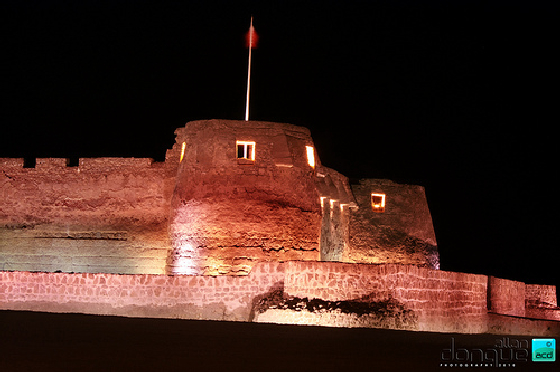
After her grandfather’s house was demolished, Sheikha Mai committed to preserving Bahrain’s venerable places Image by dunsky via flickr
Though most of our architectural news depicts ongoing developments (like in Bahrain), the BBC series giving prominence to “heritage heroes” preserving more venerable developments, marinated in history, has steered our green news reel in a different direction.
We are especially proud to brag about the shepherds fielding one-third of all UNESCO’s world heritage sites in the Middle East. Sheikha Mai was the first such shepherdess to shine in the BBC’s spotlight.
Also Bahrain’s first female Minister of Culture, Sheikha Mai became interested in Bahrain’s historic settlements when her grandfather’s home was demolished. She told Time Out Bahrain that her grandfather, Shaikh Ebrahim bin Mohammed Al Khalifa was a central cultural personality in Bahrain during the early 1900s, so she founded the Shaikh Ebrahim Centre as a tribute to his legacy. The center is also the platform from which she launched her initial architectural preservation programs.
 Among the projects on Bahrain’s defensive radar are traditional houses in Muharraq, the former capital, a Pearl Heritage Trail also in Muharraq, and the famous burial mounds that are unique to Bahrain.
In addition to her efforts to preserve it, Sheikha Mai has miraculously found the time to publish 10 books about Bahrain’s heritage. UNESCO was so impressed by this progress that they chose the smallest Arab state to host the World Heritage Regional Centre for Arab countries.
Sheikha Mai’s work should not overshadow that of the Middle East’s proceeding heroes: Be sure to visit the BBC’s Heritage Heroes Website to learn more about programs featuring the following sites: Beirut, 26th and 27th of June, Saudi Arabia 10th, and 11th of July, Morocco 17th and 18th of July, and Turkey on the 24th and 25th of July.
Also stay tuned for a discussion among a panel of urban experts who met in Riyadh to unwrap the numerous challenges facing a heritage preservationist. They are numerous, the challenges, so we salute the people who stand up against them.
[image by Hussain Shafei via flickr]
Green Prophet: Muslim World Takes Steps for Making the Hajj Green
Posted by Zaufishan Eco-Islam, Green-Muslims, guest posts, hajj, Islam-Environment, websites Wednesday, April 21, 2010In the name of God, compassionate & merciful بِسْمِ اللهِ الرَّحْمنِ الرَّحِيمِ | Peace be with you السلام عليكم
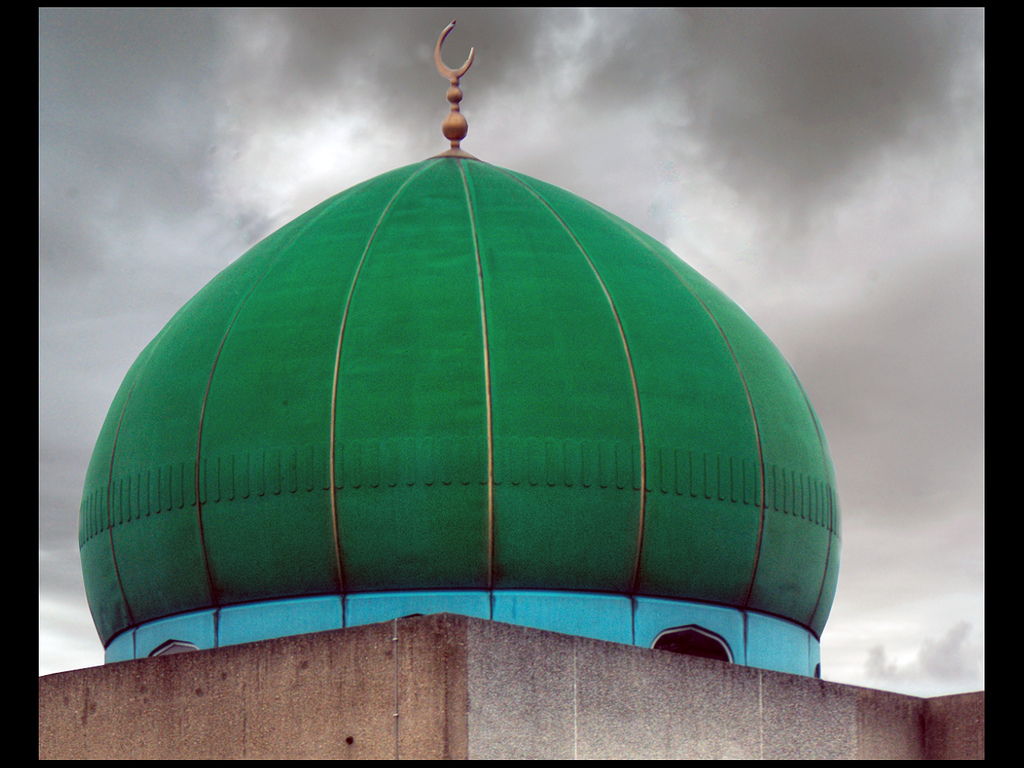
Muslims recognize the Qu’ran has a lot to teach about ecology. A critical mass of Muslims are now working to make the annual Hajj pilgrimage greener. Green was, after all, Mohammad’s favorite color. Image via jonathangill
Ask around in Egypt and the environment is usually not on the top of most people’s agenda, especially considering the vast number of people living in poverty, unemployment rising, sexual harassment burgeoning and a government that constantly pushes its people toward oblivion. But that is not stopping a number of Muslim activists from speaking out on environmental issues, with calls in Jakarta recently at an environmental conference to turn the Islamic pilgrimage, or the Hajj, green.
The movement sees no qualms in combining faith with environmental protection. They argue that global warming does not discriminate between religion or region, activists said at the Jakarta meeting of the international Islamic green movement’s meeting.
Leading activist Mahmoud Akef of the Earth Mates Dialogue Center was one of nearly 200 Muslim delegates from across the world to call for a greener Hajj: “Because we are all living on this Earth and what is happening, or what’s affecting with regard to the climate change, affecting Americans, affects the Muslims here in Indonesia, affects Egypt, Muslims in Africa and Asia anywhere,” Akef said at the conference.
While the West has had lobbyists calling for environmental reform and a push toward ending carbon emissions to curtail global warming and climate change, for the post part, Muslim leaders and activists have shied away from the discussion. This is changing, and Akef is leading the charge.
He said that Muslim environmentalists want to have the message about climate change and global warming heard around the world, in the Middle East, in Islamic countries and in the mosques.
At the conference, the leaders announced a desire to implement a greener Hajj, where some three million Muslims participate in annually in Mecca, Saudi Arabia. They argued that it is the ideal location to raise awareness of global warming and the environmental impact individuals have.
The plan includes a ban on plastic bottles at Hajj sites and workshops about the link between environmental stewardship and the teaching of Islam.
Qu’ran as book of ecology
“The Qu’ran is kind of ecology book. A lot of verses tell about the environment and how to deal with the environment and how to protect the environment,” Akef said.
They are also looking into designating eco-friendly mosques and publish Islam’s Holy Book with paper from sustainable forests.
Muhammad Sembiring, part of the Indonesian environmental organization Kehati, says Muslim activists see no conflict between science and faith on the issue of the environment.
“It is proven there is totally no conflict, it is really [a] complement and it is shaking hands, it is matching,” Sembiring said.
The conference agreed that the meeting was a good starting point, but they added that a new approach to educating the larger population is needed in the near future.
(This story was reposted from the Egypt-based news site Bikya Masr.
Peace & respect ★ www.Muslimness.com





